
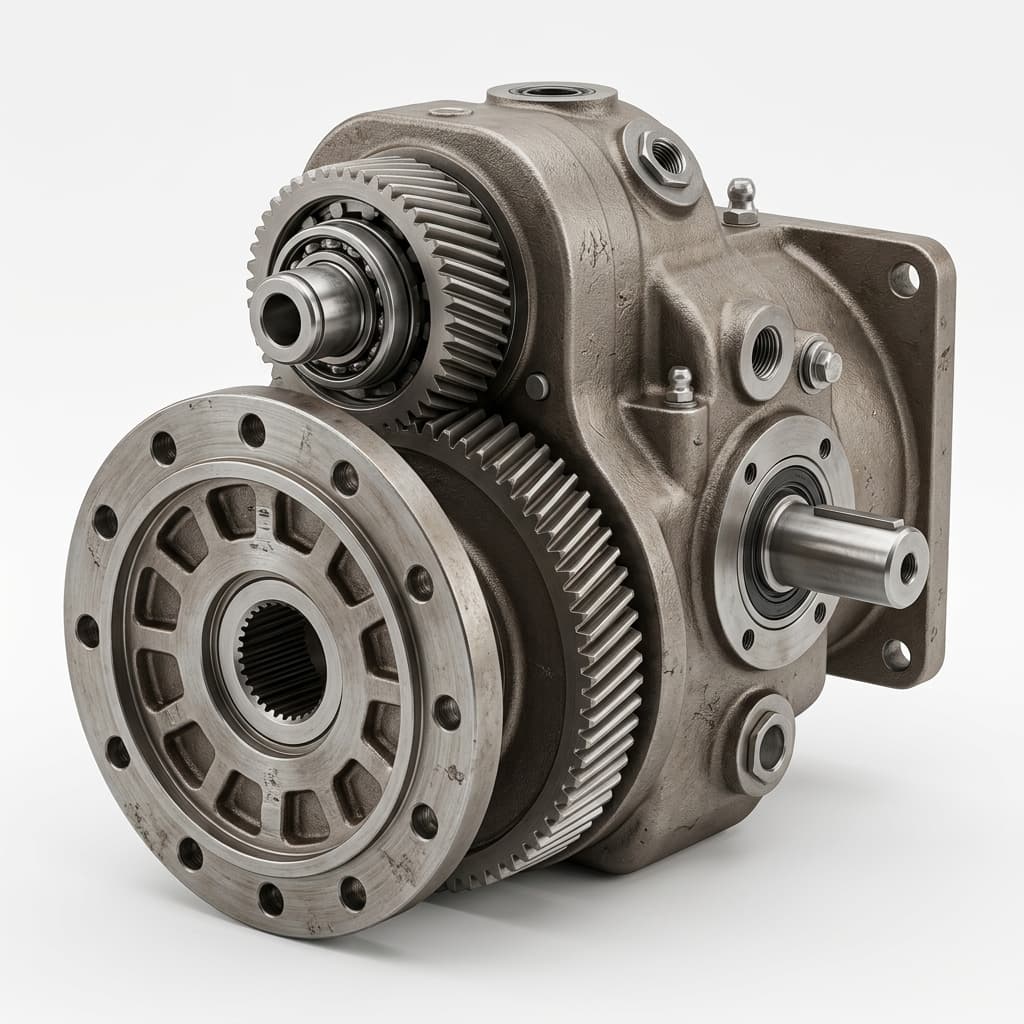
Nabtesco RV Gearbox Replacement: How to Verify Drop-In Compatibility from Chinese Suppliers
A procurement guide for sourcing RV-style cycloidal reducers from China. Learn how to verify drop-in compatibility, stiffness, and shock load capacity before switching.
When lead times for Japanese RV gearboxes (like Nabtesco) stretch from weeks to months, or when cost-reduction mandates force OEMs to explore alternative supply chains, sourcing heavy-duty cycloidal reducers from China becomes a strategic priority.
The decision to switch away from an incumbent robotic reducer brand (such as Nabtesco or Spinea) is rarely taken lightly. The primary drivers are usually cost reduction on high-volume machine builds, escaping unacceptable lead times (often exceeding 6 months for certain frame sizes), or securing a secondary source to mitigate supply chain shocks.
Executive Summary
- Drawings over Models: Never rely solely on a model number match. True drop-in compatibility requires a millimeter-perfect 2D/3D interface drawing review.
- Stiffness is King: A visually identical gearbox will fail if its torsional stiffness (rigidity) cannot match the incumbent's hysteresis curve.
- Actionable Step: Use our live Cross-Reference Interchange Matrix to instantly match your Nabtesco or Spinea part number, or request our Drop-in Replacement Review Service.
However, moving from an incumbent Tier 1 brand to an alternative supplier is never a simple keyword-matching exercise. An RV reducer is the mechanical heart of an industrial robot or heavy-duty welding positioner. Replacing it without proper engineering validation introduces severe risks to machine accuracy, warranty claims, and production uptime.
This guide outlines how procurement and engineering teams can confidently verify drop-in compatibility, establish performance parity, and audit Chinese RV gearbox manufacturers.
1. Beyond the Model Number: The Drawing is King
Many buyers initiate the RFQ process by simply sending an incumbent model number (e.g., RV-110E or RV-320C) and asking for a direct cross-reference and price. While this is a valid starting point for supplier screening, it is highly dangerous to issue a purchase order based on a model number alone.
True "drop-in compatibility" means absolutely zero modifications to your robot's expensive castings, motor mounts, or tooling plates. To verify this, you must transition from model numbers to rigorous 2D/3D interface drawing reviews.
Critical Dimensions to Verify on the Interface Drawing:
Don't Guess Your Replacement
Stop manually comparing PDF catalogs. Enter your incumbent's exact part number into our Live Cross-Reference Matrix to find the technically equivalent RobotizedGearbox model and its corresponding interface drawing immediately.
- Pilot Diameter (Spigot) Tolerances: This is the primary alignment feature. A mismatch in the pilot tolerance (even by a few microns) leads to eccentric loading, vibration, and rapid input gear failure.
- Bolt Circle Diameter (BCD) & Thread Depth: Ensures the new gearbox mounts securely to the existing robot arm casting without bottoming out the bolts.
- Input Sun Gear Adapter: Does the supplier provide a custom sun gear matched to your specific servo motor shaft (diameter, keyway, or spline), or are they expecting you to modify the motor shaft?
- Overall Axial Length (OAL): Crucial for enclosed joint modules where internal space is strictly constrained by external covers and cable routing.
2. Dynamic Performance: Stiffness and Shock Load
A visually identical gearbox can behave very differently under heavy dynamic loads. The two most critical performance metrics for heavy-duty RV reducers are Torsional Stiffness and Shock Load Capacity.
Torsional Stiffness (Rigidity)
In heavy-payload applications (e.g., a 50kg welding robot), the arm acts as a long mechanical lever. If the base gearbox lacks torsional stiffness, the arm will experience "wind-up" during acceleration and oscillation (wobble) when stopping. This destroys cycle time because the robot must wait for the vibration to settle before the tool can perform its task.
Procurement Action: Request a hysteresis curve from the alternative supplier. Compare the lost motion (measured in arcmin) at rated torque against the incumbent brand's spec sheet. If the alternative is significantly "softer," it is not a true replacement.
Emergency Stop (Shock Load) Capacity
Industrial robots crash. An E-stop event at full speed with a maximum payload generates an immense shock wave through the drivetrain. High-quality RV reducers are designed to withstand instantaneous shock loads up to 500% of their nominal torque without catastrophic failure or permanent plastic deformation of the cycloidal pins.
Procurement Action: Ask the supplier for their shock-load testing methodology. How many E-stop cycles is the gearbox rated for, and what is the measured backlash degradation after the test?
3. Comparing the Incumbent vs. Alternative
Use this checklist when evaluating a Chinese RV gearbox against a Tier 1 incumbent:
| Evaluation Criterion | Incumbent Standard | Alternative Validation Requirement |
|---|---|---|
| Dimensional Interface | Guaranteed by legacy drawings. | Must provide a signed 2D drawing matching the legacy pilot and BCD tolerances. |
| Material & Heat Treatment | Proprietary steel alloys and precise nitriding. | Request material certs for cycloidal discs and pin rings; ask about their heat treatment facility (in-house vs outsourced). |
| Lost Motion / Backlash | Typically under 1 arcmin. | Must guarantee under 1 arcmin and provide a sample inspection report with a hysteresis curve. |
| Main Bearing Capacity | High-capacity integrated angular contact bearings. | Verify the dynamic load rating (C) and static load rating (C0) of the integrated main bearings. |
| Lubrication Compatibility | Molywhite or Vigogrease. | Confirm the factory-filled lubricant brand or verify compatibility with your existing maintenance grease. |
4. Lubrication and Sealing Validation
A gearbox is only as good as its lubrication film. When swapping suppliers, ensure the thermal and lubrication parameters remain compatible with your existing maintenance schedules.
- Sealing Integrity: Standard NBR seals degrade quickly if the gearbox runs hot or if the application involves machining coolant or welding spatter. Specify FKM (Viton) seals for harsh environments and ensure the supplier performs pneumatic leak-tests on 100% of units before shipment.
- Paint and Finish: For export machinery, specify the paint type (e.g., epoxy primer) and rust-preventative oil for unpainted machined surfaces to survive ocean freight.
5. The Phased Validation Strategy
Never switch an entire production line to a new gearbox supplier overnight, regardless of the cost savings. Implement a phased engineering validation approach:
- Phase 1: Drawing & Data Review. Align all physical dimensions, stiffness curves, and bearing load ratings.
- Phase 2: Bench Testing (1-2 units). Run the sample gearbox on a dynamometer to verify acoustic noise, thermal rise, and zero-load starting torque.
- Phase 3: Prototype Machine Integration. Install the unit in one robot or positioner. Run a high-cycle endurance test (e.g., 500 to 1,000 hours) with a maximum payload to evaluate settling time and collision detection behavior.
- Phase 4: Teardown Inspection. Disassemble the prototype gearbox after the endurance run to check for abnormal wear patterns on the cycloidal discs, pin ring, or main angular contact bearings.
Conclusion
Sourcing RV gearboxes from China offers significant cost reductions and lead-time advantages, but it requires a disciplined, engineering-led procurement process. By focusing on exact interface drawings, torsional rigidity, shock load testing, and phased validation, OEMs can successfully de-risk the transition and secure a highly reliable, cost-effective supply chain.
Are you evaluating alternatives for Nabtesco or other incumbent RV reducers? Contact the RobotizedGearbox engineering team for a detailed drawing review and drop-in compatibility assessment.
Author

Categories
More Posts
Robotized Gearbox RFQ Guide for Industrial Automation Buyers
An engineering checklist for sourcing robotized gearboxes, cycloidal reducers, and AGV drives without creating hidden integration risk. Learn what data your supplier actually needs.
Specifying Gearboxes for High-Payload Cobots: Why 20kg+ Arms Require Cycloidal Drives
Learn how to specify high-payload cobot gearboxes for 20kg+ arms: harmonic vs cycloidal tradeoffs, joint architecture, RFQ checks, and supplier evidence.
Preventing Thermal Failure in AGV and AMR Drive Gearboxes: A Sourcing Guide
Why compact AGV wheel gearboxes fail from heat before they fail from load, and how procurement and engineering teams can specify thermal limits correctly.