
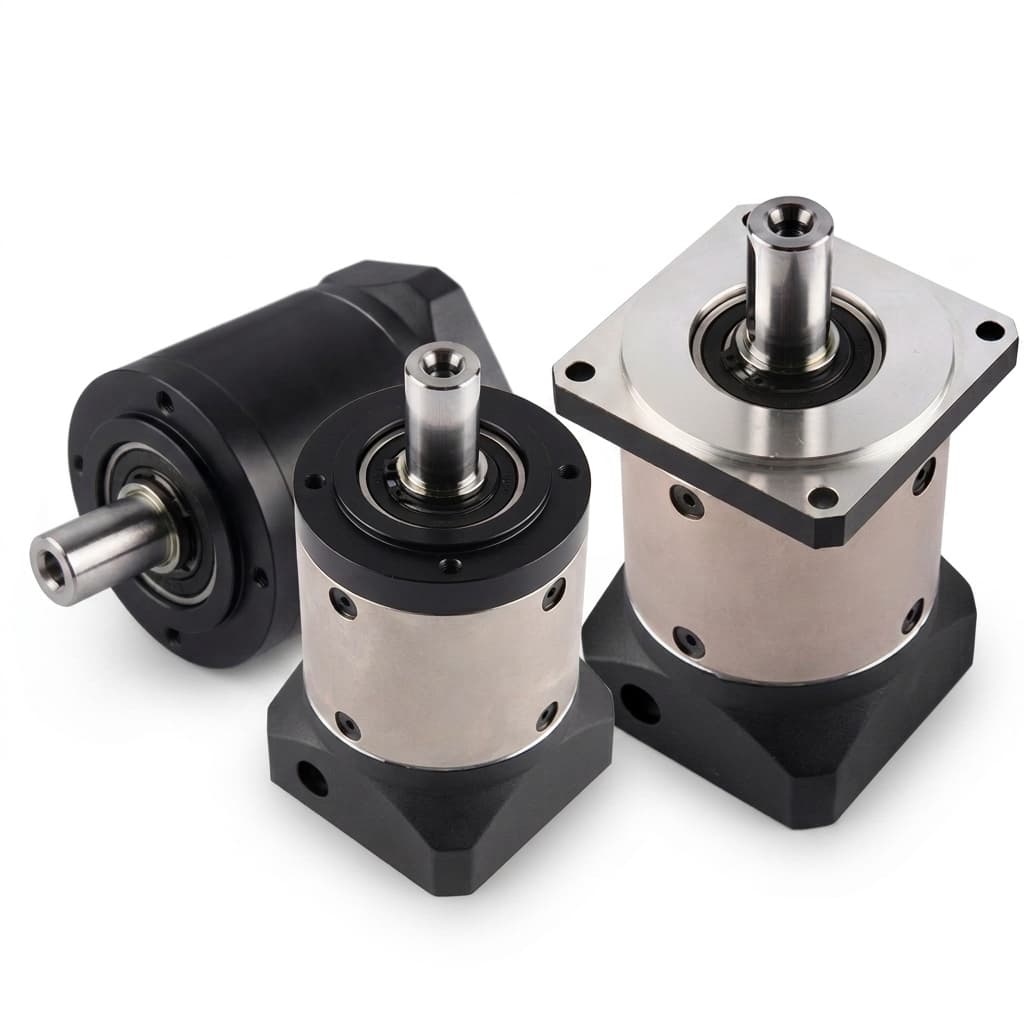
Hollow Shaft Gearboxes for Rotary Automation: Cable Routing and Moment Load Guide
How to specify hollow shaft gearboxes for robot wrists, rotary tables, and AGVs. Learn to balance through-bore clearance, thermal risks, and moment load capacity.
As industrial automation becomes more highly integrated, the physical space available for external cable management is rapidly disappearing. Machine builders are increasingly routing power, data, and pneumatic lines directly through the center of rotation using hollow shaft gearboxes.
While a hollow-bore design drastically simplifies the external footprint of a robotic wrist, rotary indexer, or AGV steering module—and prevents cables from snagging on surrounding equipment—it significantly complicates the internal mechanics and thermal profile of the gearbox.
This guide explains how to properly specify a hollow shaft reducer without compromising mechanical rigidity, thermal safety, or cable integrity.
Executive Summary
- The 15% Rule: Never size the hollow bore exactly to the cable bundle diameter. Torsional expansion requires at least a 15% clearance to prevent catastrophic short circuits.
- Moment Load Constraints: Pushing bearings outward to create a hollow bore limits moment capacity. Always specify Cross-Roller Bearings for eccentric loads.
- Actionable Step: Review our Hollow Shaft Robotized Gearboxes which are factory-sealed with FKM/Viton to isolate the internal grease from the cable bore.
1. Sizing the Through-Bore: The 15% Clearance Rule
The single most common mistake when specifying a hollow shaft gearbox is sizing the bore exactly to the diameter of the cable bundle.
When a rotary module moves (for example, a robot wrist pitching 180 degrees), the cables inside the bore twist. This torsion causes the cable bundle to expand radially. If the bore is too tight, the expanding cables will chafe aggressively against the spinning inner wall of the gearbox shaft. Over thousands of cycles, this strips the insulation, leading to catastrophic short circuits or pneumatic leaks.
Engineering Best Practice: Calculate the maximum outer diameter of your combined cable and hose bundle, and add at least a 15% to 20% safety clearance to determine your absolute minimum required through-bore diameter.
2. Harmonic vs. Cycloidal (RV) Hollow Shafts
When selecting a hollow shaft gearbox, engineers typically choose between two architectures. The choice depends entirely on the required payload and precision.
| Architecture | Hollow Bore Capacity | Load / Rigidity | Best Application Fit | Limitations |
|---|---|---|---|---|
| Hollow Harmonic Drive (Strain Wave) | Very Large relative to overall outer diameter (OD). | Low to Moderate moment load; extremely lightweight. | J4-J6 Robot Wrists, Semiconductor handlers, Optical dials. | Vulnerable to high shock loads; stiffness drops under heavy load. |
| Hollow RV Drive (Cycloidal) | Moderate (requires a larger overall OD to achieve the same bore). | Massive moment load capacity; extreme torsional stiffness. | J1-J3 Robot Bases, Heavy Welding Positioners, AGV Steering. | Heavier physical weight; slight increase in backlash vs Harmonic. |
If your application requires very low backlash and handles light payloads, a hollow-shaft Harmonic Drive can be a strong fit. If you are mounting a 50kg welding fixture offset from the center of rotation and require high rigidity, a hollow-bore RV cycloidal reducer is usually the safer architecture to evaluate first.
3. Managing Moment Load Capacity (Overhung Load)
In a standard solid-shaft gearbox, the output bearings are positioned close to the center axis, providing excellent resistance to tilting forces.
In a hollow shaft gearbox, the internal torque-transmitting components (sun gears, planetary carriers, or cycloidal discs) must be pushed outward radially to make room for the central bore. This structural change often requires the main output bearings to have a larger diameter but a narrower cross-section.
If you mount a heavy end-effector (like a large rotary table dial or an eccentric tooling arm) offset from the center of rotation, you generate a significant Moment Load.
What to verify during RFQ:
- Check the supplier's rated Allowable Moment Load (expressed in Nm).
- Ensure the gearbox utilizes high-capacity Cross-Roller Bearings or heavy-duty Angular Contact Bearings at the output flange. Cross-roller bearings can handle high radial, axial, and moment loads simultaneously within a very compact axial space, making them ideal for hollow shaft designs.
4. The Hidden Risk: Thermal Buildup in the Bore
A hollow shaft acts like an insulating pipe running completely through the center of the gearbox.
When cables—especially heavy power cables for welding torches or large servo motors—carry high current, they generate heat. Simultaneously, the gearbox itself generates heat from gear friction and churning losses. Because the cables are confined inside the hollow steel shaft with limited airflow, this creates a localized thermal hotspot.
Mitigation Strategies:
- Ensure the power cables are appropriately de-rated for confined spaces.
- If continuous high-speed rotation is required, ask the gearbox supplier if a higher-temperature synthetic lubricant is recommended to handle the localized heat without losing viscosity.
5. Sealing the Hollow Bore
While the hollow shaft is great for routing cables, it is also a direct tunnel for environmental contaminants to enter the heart of your machine.
If your rotary module operates in a harsh environment (machining chips, coolant washdown, or welding dust), you must ensure that both ends of the hollow bore are adequately sealed after the cables are routed.
- Supplier Responsibility: The gearbox manufacturer is responsible for sealing the internal mechanism (the gears, bearings, and grease) away from the hollow bore using heavy-duty rotary lip seals (preferably FKM/Viton).
- Integrator Responsibility: The machine builder must provide external strain relief and environmental sealing at the entry and exit points of the hollow shaft. Use customized cable glands, flexible boots, or potting compound to prevent external liquids from flowing down the cable bundle and into the machine structure.
Conclusion
Hollow shaft gearboxes are essential components for modern, uncluttered, and highly reliable machine design. By carefully balancing the required cable clearance against the necessary moment load capacity, thermal risks, and bearing architecture, engineering teams can build superior rotary modules.
Need help sizing a hollow shaft reducer for your next automation project? Submit your payload, speed, and bore requirements to the RobotizedGearbox engineering team for a technical review.
Author

Categories
More Posts
Nabtesco RV Gearbox Replacement: How to Verify Drop-In Compatibility from Chinese Suppliers
A procurement guide for sourcing RV-style cycloidal reducers from China. Learn how to verify drop-in compatibility, stiffness, and shock load capacity before switching.
Specifying Gearboxes for High-Payload Cobots: Why 20kg+ Arms Require Cycloidal Drives
Learn how to specify high-payload cobot gearboxes for 20kg+ arms: harmonic vs cycloidal tradeoffs, joint architecture, RFQ checks, and supplier evidence.
Robotized Gearbox RFQ Guide for Industrial Automation Buyers
An engineering checklist for sourcing robotized gearboxes, cycloidal reducers, and AGV drives without creating hidden integration risk. Learn what data your supplier actually needs.